
I started researching peptides not because someone recommended them, but because I’d exhausted a lot of the conventional options and kept landing on the same research papers from different angles. The biology made sense to me in a way that a lot of supplement claims don’t. These aren’t compounds trying to fake out your body — they’re signals your body already recognizes, just delivered at the right time, in the right amount.
This article is what I wish existed when I started. I’ll be direct about what the evidence actually shows, which peptides do what, and where the lines between “promising” and “proven” sit.
Why Inflammation Is Harder to Treat Than It Looks

Most people think about inflammation the wrong way. They imagine it as purely bad — something to suppress, shut down, eliminate. But inflammation is also how your body repairs itself. The problem isn’t inflammation existing. The problem is when it doesn’t switch off.
This distinction matters enormously when you’re looking at treatment options. NSAIDs work by blocking an enzyme called COX-2, which reduces prostaglandin synthesis and therefore pain and swelling. That’s useful short-term. The catch is that COX-2 also plays a role in tissue repair — meaning the very drug you’re using to reduce inflammation is also slowing down healing. Long-term NSAID use compounds this with cardiovascular risks, GI damage, and impaired kidney function.
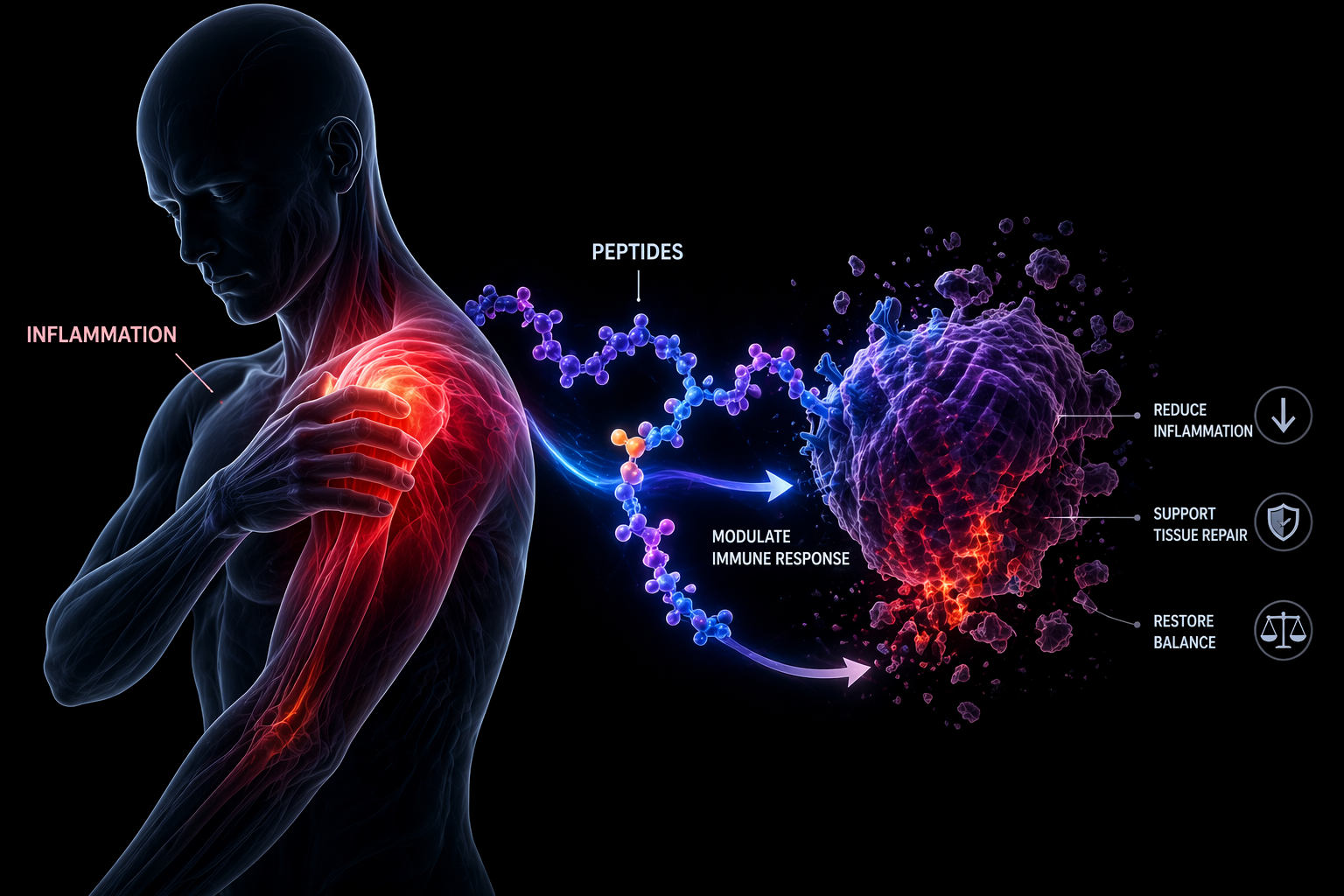
Peptides (BPC – 157)take a different approach. Rather than blocking a single enzyme, they modulate the upstream signals — the cytokines, the transcription factors, the macrophage behavior — that determine whether inflammation runs its course productively or spirals into the chronic state that damages tissue over months and years. This is a meaningful distinction, not marketing language.

How Peptides Actually Work Against Inflammation
The Cytokine Connection
The inflammatory cascade is largely driven by signaling molecules called cytokines — specifically TNF-alpha, IL-6, IL-1beta, and interferon-gamma. These are the “alarm signals” that tell your immune system something is wrong and needs attention. In acute inflammation, this is appropriate. In chronic inflammation, these signals are elevated constantly, driving ongoing tissue damage even when there’s no active injury to repair.
Several peptides work by reducing the production of these pro-inflammatory cytokines while simultaneously nudging the immune system toward a more reparative state. What makes this interesting is that they don’t simply suppress the immune system the way corticosteroids do — they modulate it. The goal is resolution, not suppression.
The NF-kB Problem
If cytokines are the alarm, NF-kB (nuclear factor-kappa B) is the alarm control panel. It’s a master regulator of inflammatory gene expression — when it’s activated, it triggers the production of dozens of inflammatory proteins throughout the body simultaneously. Chronic inflammatory conditions often involve persistently elevated NF-kB activity.
Peptides like GHK-Cu and KPV inhibit NF-kB activation, which explains why their effects are so broad. Reducing inflammatory signaling at this upstream level creates downstream effects across multiple tissues and organ systems at once. Some research suggests reductions in inflammatory markers of up to 60% through this mechanism, though results vary considerably by individual and condition.
Macrophage Polarization — The Under-Discussed Mechanism
Your immune system’s macrophages exist in two general states. M1 macrophages drive inflammation — they’re the ones responding to threats and producing the cytokines mentioned above. M2 macrophages do the opposite: they clean up debris, promote tissue repair, and help resolve inflammation. In chronic inflammatory conditions, the balance is chronically skewed toward M1.
BPC-157 in particular has shown in preclinical models that it promotes this shift from M1 to M2 macrophage activity. This isn’t just anti-inflammatory in the passive sense — it’s actively pro-healing. The distinction matters because it means the peptide isn’t simply muting your immune system; it’s redirecting it toward productive work.
The Best Peptides for Inflammation: A Practical Breakdown

BPC-157 : “king of healing”
BPC-157 stands for Body Protection Compound-157. It’s a synthetic pentadecapeptide — fifteen amino acids — derived from a protein naturally found in gastric juice. That origin isn’t coincidental. The gastric environment is a place where tissue is continuously exposed to acid and mechanical stress, and yet heals constantly. Researchers isolated this compound specifically because it seemed to be part of why.
The inflammation-related evidence for BPC-157 is more substantial than most people realize. It reduces pro-inflammatory cytokines including IL-6, TNF-alpha, and interferon-gamma. It decreases COX-2 gene expression — but unlike NSAIDs, it does this while simultaneously supporting angiogenesis and collagen synthesis, meaning healing continues. A 2025 systematic review in orthopedic sports medicine confirmed it promotes healing and reduces inflammation across fracture, muscle, tendon, and ligament injury models.
What makes BPC-157 particularly interesting for gut-driven inflammation is its mechanism in the GI tract. Chronic systemic inflammation is frequently downstream of intestinal permeability — the gut lining gets compromised, bacterial products enter the bloodstream, and the immune system responds continuously. BPC-157 has shown specific activity in restoring gut epithelial integrity and reducing intestinal inflammation, which can have downstream effects on systemic inflammatory markers.
Best for: Tendinopathies, ligament injuries, muscle strains, gut inflammation, post-surgical recovery
TB-500: Systemic Where BPC-157 Is Local
TB-500 is the synthetic version of a fragment of thymosin beta-4 — a naturally occurring 43-amino acid peptide found in high concentrations in platelets and wound-healing tissues. That’s not an accident of biology. Thymosin beta-4 concentrations spike at injury sites because the body uses it as part of its repair signaling.
The primary mechanism is regulation of actin dynamics. Actin is the structural protein that determines how cells move and reorganize. By influencing actin filament assembly, TB-500 enables cell migration to injured tissue — a prerequisite for healing. Beyond this, it reduces TNF-alpha and IL-6 production, increases the anti-inflammatory IL-10, and has shown protective effects against tissue damage in sepsis models by limiting microthrombi formation and endothelial injury.
The key practical distinction from BPC-157: TB-500 operates more systemically. BPC-157 is typically used closer to the injury site; TB-500 circulates more broadly. For widespread or chronic inflammatory conditions — the kind that don’t have one specific location — this broader action can be advantageous.
They’re frequently used together for this reason. The combination isn’t just convenient marketing. There’s a logical rationale: BPC-157 accelerates local repair while TB-500 supports systemic cellular migration and anti-inflammatory signaling simultaneously. A 2021 study on regenerative peptide combinations found synergistic changes in gene expression that exceeded what either peptide produced individually.
Best for: Widespread musculoskeletal inflammation, cardiovascular-adjacent inflammatory conditions, chronic recovery, systemic tissue repair
GHK-Cu: The Copper Peptide Most People Underestimate
GHK-Cu is glycine-histidine-lysine complexed with copper. It occurs naturally in human plasma, urine, and saliva, with concentrations that decline significantly with age — from roughly 200 ng/mL in young adults to around 80 ng/mL by age 60. That age-related decline correlates interestingly with the increase in chronic inflammation that comes with aging.
GHK-Cu’s anti-inflammatory action runs through several channels. It inhibits NF-kB activation. It enhances superoxide dismutase activity, which is the body’s primary antioxidant defense against the oxidative stress that amplifies inflammation. It also downregulates the genes involved in inflammatory signaling while upregulating genes associated with tissue repair and regeneration — over 4,000 genes are reportedly influenced by GHK-Cu according to gene expression analyses, which is a remarkable breadth for a single compound.
A 2025 study published in Frontiers in Pharmacology examined GHK-Cu in a ulcerative colitis mouse model and found meaningful reductions in inflammatory markers and improved mucosal integrity. For skin inflammation specifically — conditions like psoriasis, eczema, and chronic dermatitis — GHK-Cu has a stronger evidence base than most peptides because topical applications have been studied more extensively.
What I find most compelling about GHK-Cu is not any single dramatic effect, but the consistency of its influence across different tissue types. Most anti-inflammatory interventions are organ-specific. GHK-Cu seems to work wherever there’s chronic inflammation and oxidative stress — which makes sense given that it operates at the transcriptional level.
Best for: Age-related chronic inflammation, skin inflammatory conditions, oxidative stress, as a systemic add-on to other protocols
Thymosin Alpha-1: The Immune Modulator
Thymosin Alpha-1 (Tα1) is a 28-amino acid peptide naturally produced by the thymus gland. Its mechanism is distinct from the peptides above — rather than directly targeting cytokines or repair pathways, it operates primarily on immune system regulation. It activates dendritic cells and T-cell precursors, increases T helper cell counts, enhances NK cell activity, and modulates the balance between pro- and anti-inflammatory immune responses.
This makes Thymosin Alpha-1 particularly relevant for inflammation driven by immune dysregulation — autoimmune conditions, chronic infections, and situations where the immune system has essentially lost the plot and is attacking its own tissues. A 2025 meta-analysis of five randomized controlled trials involving 706 patients with severe acute pancreatitis found that Thymosin Alpha-1 significantly reduced TNF-alpha, IL-1beta, and IL-6 levels while improving immune markers including CD4+ percentages and reducing secondary infection risk.
The dual action — enhancing immunity when it’s suppressed while dampening it when it’s overactive — is what makes Thymosin Alpha-1 genuinely useful. Most immune interventions push in one direction. This one calibrates. For people dealing with chronic fatigue syndromes, recurrent infections alongside inflammation, or conditions where the immune picture is complicated and mixed, this calibrating property is often exactly what’s needed.
Best for: Autoimmune-driven inflammation, immune-suppressed states with concurrent inflammation, chronic viral conditions, severe inflammatory diseases
Conclusion
Chronic inflammation is one of those problems that conventional medicine doesn’t manage particularly well — partly because it’s complex, partly because the treatments that work best (lifestyle changes, time) are hard to monetize, and partly because the available options have significant side effects at the doses needed to make a real impact.
Peptides are a revolution! They represent a legitimate addition to the therapeutic toolkit. BPC-157 for local tissue repair and gut inflammation. TB-500 for systemic healing support. GHK-Cu for anti-inflammatory and antioxidant effects at the level of gene expression. Thymosin Alpha-1 for immune system modulation. KPV for targeting gut inflammation and receptor-level pathways.
But for people dealing with persistent inflammation that doesn’t fully resolve despite doing the right things — this is a category worth understanding in depth and discussing seriously. Peptides are truly revolutionary in the real sense of the word.